


Movify: AI Video Generator
botiix
I opened Movify: AI Video Generator looking for a simple way to turn still images into something more expressive than a standard slideshow. It sits in the art and design space, but its appeal is practical: you bring in a photo, try an AI-led transformation, improve the image, or add a creative effect, then decide whether the result is good enough to share. My experience was less about replacing a full video editor and more about finding a quick visual shortcut when an ordinary picture needs movement or atmosphere.
That distinction matters. Movify is aimed at people who want an accessible creative experiment rather than a timeline packed with manual controls. I found it most interesting when I started with a clear visual idea, such as giving a portrait a more animated presentation or making a product image feel less static. If you expect precise keyframes, detailed audio mixing, or professional color work, you should approach it as a companion tool instead of your main editor.
From a still image to a shareable visual
Choosing the right starting image
The first useful lesson is that the input does much of the creative work. A sharp, well-lit image gives an AI effect more to work with than a dark screenshot, a heavily compressed social-media download, or a picture with several subjects competing for attention. Before importing anything, I would choose the cleanest original available and crop away distractions. This small preparation step can make the final transformation look intentional rather than merely automatic.
For a realistic everyday example, imagine I have taken a portrait for a friend’s birthday post. The photo is pleasant but flat, and I do not want to build a complete video from scratch. I can use Movify to explore a more animated treatment, enhance the source first, and then judge whether the movement supports the mood. The workflow is particularly useful when the image already has a strong subject but lacks the visual energy needed for a short post.
I would not begin with a folder of random images. AI effects are easier to evaluate when the purpose is defined: a portrait, a travel memory, a small business image, or a creative test. Starting with one image also makes it easier to notice whether an effect improves the subject or simply adds motion for its own sake.
Related News

Why WhatsApp Messenger Still Makes Everyday Communication Feel Easy

Jurassic World: The Game Is the Better Dino Tycoon for Strategic Players

Threads in Real Life: Who Should Join, Lurk, or Leave

How SHEIN Turned Shopping Into an Endless Content Feed

How to Make Fortnite Feel Smarter on Mobile

Should You Switch to Microsoft Outlook on Mobile?
Working through enhancement before animation
Movify combines image enhancement with photo-to-video creation, so the order of operations can affect the result. In my preferred workflow, I first consider whether the source needs cleaning up. Enhancement can be useful for an image that is slightly soft or lacks impact, but it should not be treated as a repair tool for every serious photography problem. If the original is badly blurred or poorly framed, improving it may still leave the underlying weakness visible.
Once the image looks acceptable, I move toward the video treatment. The practical advantage is that the enhancement and animation stages belong to the same creative process instead of forcing me to prepare the image in one app and then transfer it elsewhere. That reduces handoffs, especially when I am working quickly on a phone. The trade-off is that a single-purpose photo editor may offer finer control over retouching, while a dedicated video editor will usually be stronger for assembling several clips.
A useful habit is to keep the original untouched and compare every generated version against it. AI effects can make an image feel more dramatic, but dramatic is not always better. I look for changes that preserve the subject’s identity and the image’s purpose. For a product photo, excessive movement may distract from the item. For a personal portrait, a subtle creative treatment may feel more natural than a highly stylized one.
Gallery
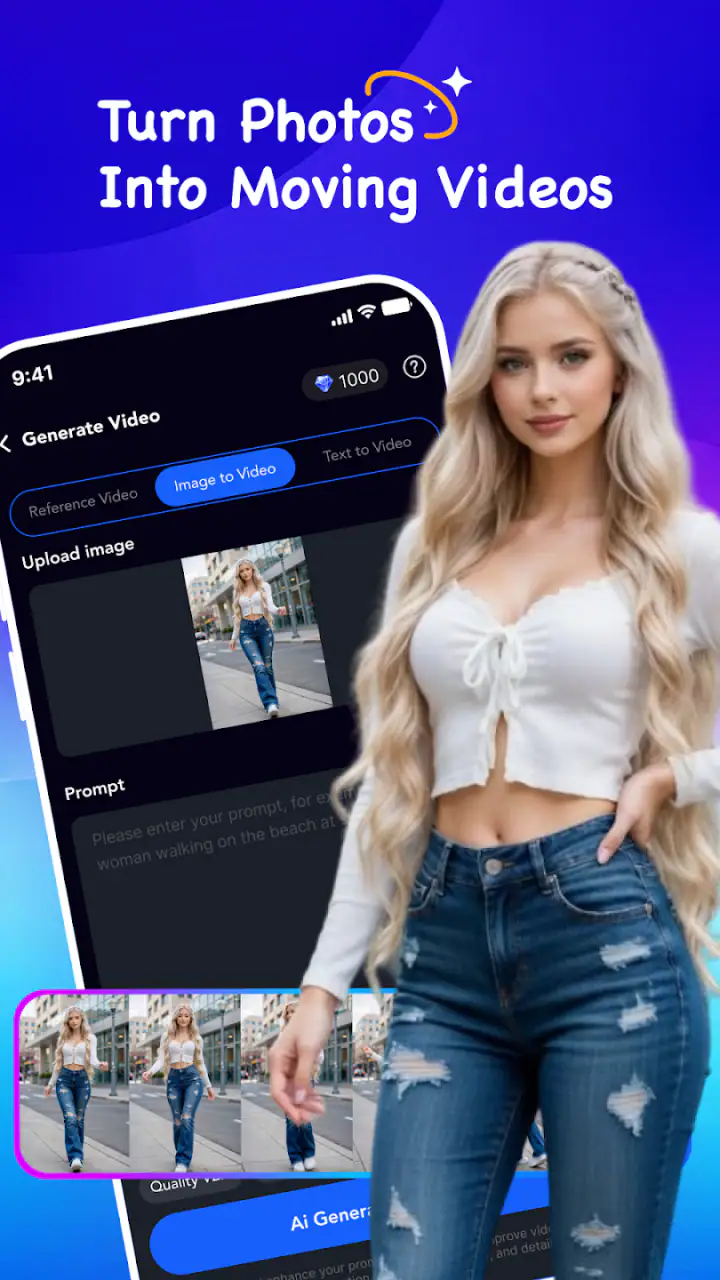
Testing creative effects without losing the subject
The creative-effects stage is where Movify feels most approachable. Instead of learning a complicated editing interface, I can explore a visual direction and decide whether it matches the image. This is helpful for casual creators who know the mood they want—energetic, dreamy, polished, or unusual—but do not know how to reproduce it manually.
My advice is to judge each result in context. A preview that looks impressive on its own may become distracting once placed beside text, a profile layout, or other posts. I would also check the beginning and ending of the generated piece rather than watching only the most attractive moment. A smooth-looking central section does not automatically mean the whole result feels finished.
This is one of the app’s less obvious strengths: it encourages visual iteration. I can treat the first output as a draft, identify what feels wrong, and return to the source or effect choice instead of assuming the first attempt is final. That approach is more productive than repeatedly applying stronger effects to compensate for a weak image.
Managing the handoff from image to video
The important handoff is the move from a still asset to a moving result. At that point, I stop asking whether the photo is attractive and start asking whether it can carry motion. A close-up face, a centered object, or a landscape with clear depth usually gives the transformation a stronger visual anchor than a crowded group shot.
This handoff also changes how I think about sharing. A still image can survive a quick glance, while a video needs a readable opening and a satisfying finish. I would therefore choose the source with the intended destination in mind. A birthday greeting, a small shop announcement, and a personal art experiment may all begin with photos, but they need different levels of movement and restraint.
Movify is convenient here because the creative path stays focused on the image rather than forcing me to build a project around multiple empty tracks. For a single-photo result, that simplicity is a benefit. When the project grows into a sequence of many images, the same simplicity can become a limitation because I may want more control over timing, order, captions, transitions, and sound than this kind of AI-centered workflow is designed to provide.
What the finished result is good at
The finished output works best as a quick visual asset: something to share, test, or use as a starting point for a larger project. I see the strongest value in short-form creative work where the image itself is the main attraction and the animation adds freshness. It can also help someone who has ideas but lacks traditional editing skills, because the barrier between a photo and a more dynamic presentation is lower.
For a small creator, this can shorten the path from a phone gallery to a usable concept. A café owner might begin with a carefully framed image of a new dessert, enhance it if needed, and create a livelier visual for a social post. A hobby artist could animate a finished illustration to make a portfolio preview feel less static. A traveler might turn one memorable landscape into a more engaging update without assembling a full travel montage.
Still, I would not confuse a generated visual with a complete campaign asset. The result may need a separate pass for text, branding, sound, sequencing, or platform-specific formatting. Movify helps with the visual transformation, but the final communication still depends on what I add around it.
Where the workflow becomes less comfortable
The first point of friction is control. AI creation is attractive because it removes manual effort, but that also means I may not get exactly the movement I imagined. If a particular object must move in a precise direction, if a face must remain perfectly consistent, or if a transition has to happen at an exact moment, a conventional editor can be the better choice.
The second issue is predictability. A visually pleasing source does not guarantee a pleasing animated result. Some images are simply better suited to enhancement than motion, and some effects may compete with details that should remain stable. I would plan for experimentation rather than treating the app as a one-tap guarantee.
The third consideration is cost structure. Movify is free to install, but it includes in-app purchases ranging from $1.99 to $99.99 per item. That makes it easy to try without an upfront purchase, while also making it important to understand what level of use fits my budget before relying on it for frequent production. For occasional experimentation, the free entry point is appealing. For repeated professional work, I would compare the ongoing purchase experience with a conventional editor whose pricing and controls may be easier to predict.
The mature audience label of 17+ is another reason I would not treat it as an automatic choice for younger users. Parents, teachers, or anyone preparing a shared device should consider that rating before recommending it. This does not change its usefulness for an adult creator, but it does affect who I would comfortably suggest it to.
How it compares with ordinary alternatives
Compared with a standard photo editor, Movify’s distinguishing idea is the path from image enhancement to motion. A traditional editor is usually the stronger option when I need exact retouching, layers, masks, or careful control over individual details. Movify is more attractive when the desired outcome is a quick creative transformation rather than a meticulously corrected photograph.
Compared with a conventional mobile video editor, it reduces the amount of manual assembly involved in turning one image into a moving visual. That is useful for a single-photo post, but a timeline-based app remains preferable for multi-scene storytelling, voiceovers, music placement, captions, and exact pacing. I would use Movify to generate or explore a visual idea, then move to a fuller editor if the project demanded structure.
Compared with a slideshow maker, it offers a more image-focused creative route instead of simply placing photos one after another. The benefit is a more distinctive result from a single source. The drawback is that a slideshow tool may be better when the real goal is to present a collection of memories in a controlled order.
Who should try it, and who should skip it
I would recommend Movify to an adult Android user who wants to experiment with AI-assisted visual creation, especially someone starting with photos rather than video footage. It suits social posts, personal greetings, visual mood boards, quick product concepts, and creative tests where speed matters more than frame-by-frame precision.
The app is also a sensible choice for beginners who feel blocked by traditional editing software. Instead of learning a complete production workflow, they can focus on selecting a good image, improving it when appropriate, and evaluating a generated result. That makes the creative process less intimidating.
I would skip it as a primary tool if my work depends on exact edits, repeatable commercial output, detailed audio, complex timelines, or strict control over how every element moves. I would also look elsewhere if I mainly want advanced photo retouching rather than animated effects. In those cases, the usual specialist tools are likely to save time despite requiring more learning.
Device fit, version, and practical expectations
Movify comes from developer botiix and currently appears as version 1.0.1. It supports Android 7.0 and later, which makes it accessible on a broad range of Android devices. Even so, the experience can vary with the phone’s processing ability, available storage, and the complexity of the chosen task. I would keep the original image backed up and avoid starting a time-sensitive project until I had tested the workflow on my device.
The app has passed 10K+ installs, so it is still a relatively focused tool rather than an established all-purpose creative suite. I see that as both a positive and a reason to keep expectations measured. Its narrower identity makes the photo-to-video idea easy to understand, but I would not expect the breadth of a mature editor built around every possible production need.
Because it is listed as free, trying the basic experience is less of a commitment than buying a full editing package immediately. The in-app purchase range means I would pay attention before making repeated selections, particularly if I am testing several versions of the same image. For a casual user, that is a manageable consideration; for a creator producing many assets, it becomes part of the workflow decision.
My practical workflow for better results
I would begin by choosing one original, well-composed image and deciding what the final visual is supposed to communicate. Next, I would use enhancement only when it supports that goal, not simply because the option is available. Then I would test a restrained effect before trying something more dramatic, watching the entire result and checking whether the subject remains clear.
After that, I would save the strongest version separately from the source and review it at the size where people will actually see it. A result that looks detailed on a large phone display may feel very different in a small feed preview. If the visual is for a business, I would add any necessary text or branding in a separate editing stage so the AI treatment does not obscure the message.
My final check would be practical: does the opening make sense, does the motion support the image, and would I still like the result after seeing it several times? If the answer is no, I would return to the source image rather than endlessly stacking effects. That is the most reliable way to keep the output personal instead of letting the automation dictate the style.
Final assessment
Movify is a focused AI art and design app that makes the jump from photo to animated visual feel approachable. I like it most as a fast idea generator and as a way to give one strong image a more active presentation. Its enhancement and creative-effect workflow can be useful for beginners, casual creators, and adults who want a quick result without learning a full editing suite.
Its limits are equally clear: generated motion is not the same as precise editing, and a single-image workflow cannot replace a complete video-production environment. The purchase range also deserves attention if experimentation becomes frequent. My recommendation is to try it when the starting point is a good photo and the desired outcome is a visually interesting short piece. Use Movify for creative momentum, not for control it was never meant to provide.
FAQs for Movify: AI Video Generator
What is Movify: AI Video Generator and what can I create with it?
Movify: AI Video Generator is designed to help users turn ideas, images, or written prompts into short AI-generated videos. During testing, its main appeal was the ability to create social-media-style clips without traditional editing skills. Depending on the available tools and subscription level, you may be able to animate photos, apply visual styles, add motion effects, generate scenes, and prepare content for platforms such as TikTok, Instagram, or YouTube Shorts.
Is Movify: AI Video Generator free to use?
Movify can generally be downloaded without an upfront purchase, but free access may be limited by credits, export restrictions, video length, watermarks, available templates, or processing speed. AI video generation can require considerable server resources, so the app may offer subscriptions or in-app purchases for additional credits and premium features. Before confirming a purchase, carefully review the current pricing, renewal terms, and trial conditions shown in the app store.
Does Movify require an internet connection to generate videos?
Yes, you should expect to need a stable internet connection for most important functions. AI video creation is normally processed online rather than entirely on the phone, meaning prompts, images, and generation requests may be uploaded to remote servers. Generation time can vary depending on demand and video complexity. Offline access may be limited to viewing or managing previously created projects, if that option is supported by the current version.
Can beginners use Movify, or is previous video-editing experience necessary?
Movify is aimed primarily at casual creators, social-media users, and beginners who want to produce videos quickly. Its guided workflow and prompt-based tools can be easier than using a full desktop editor, although creating consistently good results still requires experimentation. Clear prompts, suitable source images, and patience with repeated generations are helpful. Users seeking precise timeline editing, advanced audio mixing, or professional color control may find the app more limited.
What privacy and content considerations should I know before using Movify?
Before uploading personal photos, faces, documents, or other sensitive material, read Movify’s privacy policy and the permissions requested by the app. AI services may process uploaded content on external servers, and storage or deletion practices can vary. You should also make sure you own or have permission to use any images, music, logos, or characters included in a video. Avoid creating misleading, harmful, or non-consensual content, particularly when real people are involved.
Pros
- Creates videos from text prompts without advanced editing skills.
- AI-generated visuals can help turn simple ideas into engaging clips.
- Useful for social media content
- marketing
- and quick creative experiments.
- Saves time compared with manually recording and editing short videos.
- A simple interface makes the main generation tools easy to discover.
Cons
- Results may vary noticeably depending on the prompt and selected style.
- Generated videos can contain visual inconsistencies or unnatural movements.
- High-quality exports may require a subscription or consume usage credits.
- Processing times can increase when servers are busy.
- Privacy concerns may apply when uploading personal images or sensitive content.


